Friday, September 16, 2016

LEST WE FORGET MARIAN SELDES
(August 23, 1928 - October 6, 2014)

When the brilliant actress Marian Seldes died, the New York Times obituary referred to her as a 'regal personality' in New York theatre for more than six decades in plays ranging from whodunits to the work of
Tennessee Williams (The Milk Train Doesn't Stop Here Anymore) and, especially Edward Albee (A Delicate Balance, Three Tall Women, Tiny Alice).
           Perhaps she is best known as the actress who never missed a performance.  Understudies were told up front they never would go on for her.  She co-starred in Ira Levin's 1978 thriller Deathtrap for almost 1800
                                        performances and earned an entry in the Guinness Book of World Records.
She performed more than 900 times in Peter Shaffer's Equus. In 2005 she was inducted into the American Theatre Hall of Fame and in 2010 she was given a Lifetime Achievement Award at the
Tony Awards ceremony.

MARIAN AND ME


I was fortunate to be in the very packed Players Grill on June 19, 1997 when she reminisced about her life and career.  Her talk was filled with wit, wisdom, a sharp sense of humor, passion, humility and most of all her love for her beloved husband Garson Kanin whose extensive writing credits included Born Yesterday,
Three Men on a Horse, Do Re Mi and five film scripts for Tracy and Hepburn.
      She married Garson in 1990 after his marriage to actress and playwright Ruth Gordon for 32 years ended with her death. This evening marked their seventh anniversary.  She referred to their marriage as 'an amazing experience which caused her life to rhyme'.

I taped her conversation and sent it to her for review and corrections. She returned it with her edits in red ink and a note thanking me, adding "I've gone over this very quickly because I'm about to go into rehearsal for IVANOV at the Vivian Beaumont Theatre."  Kevin Kline who played the title role had been one of
                                                          her students at Juilliard.
                                                       
MS. SELDES IN HER OWN WORDS
Garson Kanin
  "I am going to introduce myself with a playwright's words. Because you never know who you are. You only imagine that. These words are from a play called Another Time by Ronald Harwood.  I think these words reflect what most of us think about the theatre.
     "I am a lover of books, a lover of poetry, a lover of art--I mean literature, the theatre, music, painting, ballet, opera. All art is an expression of what is best about each and every one of us. My belief is that art is a solace, art is a benediction. My prayers are for more Shakespeares and George Eliots. There is not a thought in my head, not a feeling in my body that art hasn't in one way or another informed and fired. I believe there is a chance that art might, just might turn the whole world upside down."

The theatre that I began in the late forties was the theatre that I had dreamed of and the theatre I thought would go on forever. Talk about denial! I thought I would do all the great classic plays and that would be my life. It never occurred to me that people wouldn't want to see them. Or that they wouldn't be done. I realized what would be greater than being in classic plays would be to create parts in new plays.
         I wanted to be a dancer.  When I went to the Neighborhood Playhouse I studied with
Martha Graham and it changed my life. She was a great teacher and I could do modern dance. I wasn't afraid of it. I think because I am tall and I think because all you've got is yourself. I was terribly lucky that I had the dream of wanting to be a dancer because it is not just important to move well, but also to not be afraid to move.
          Early in my career I was told I was too tall and I would never play opposite anybody and if you listen to that you can jump in the river. Those things are so insignificant really. They are only significant when they keep you from working.
         I really dreamed of a kind of transcendent career. Every year I would be in a great play with a great part. I mean I lived in a dream.  Lucille Lortel called me up one day and said I am going to do a play about Gertrude Stein and Alice B. Toklas.  I am fortunate enough to have had a father who knew Gertrude Stein and so I read her always.  I knew Lucille was going to give me a chance to play Gertrude and she said "And I want you to play Alice B. Toklas." I thought she knows me and what I can do.  I have never had such an experience in my life as in that part.  I went into my father's world, a world of Paris in the twenties when you could live on writing words and the romance and the greatness of their love.  I just adored it. I mention it because you don't always know what you should play. You don't always know what you can play.

FRIGHTENED OF FAILURE
                  I have a reputation in the business for never missing a performance. As a child I never missed school.  It really isn't anything to do with acting. I try not to take on anything I cannot do. I'm frightened of failure.  I'm frightened of not getting someplace on time, of not showing up. I have tremendous anxieties so that my way of quelling them is to establish a record I cannot break. The other part is childish too. It is sort of your own part. From the time you play it, it is really yours.

DEATH TRAP
                Death Trap was the first play I was in in which the excitement of the audience was almost palpable.  The shrieking and screaming would be there every night and it was extremely exciting. It was a wonderful experience to do and I loved it. When people say, well you were in it 1,800 times, I never say well I was in half of it, because of course they killed me.  You might ask me why I stayed so long in the play. I am going to tell you the truth and it troubles me in a way. Because nothing else came my way!  I wasn't really looking for a world record. I would have gone. But I am not good at seeking things out and I am not good at self-promotion.  I'd have gone, but if I could live the Death Trap experience over again, I would have fired my agent and I would be a really big star now.
             I didn't mind. I was teaching at Juilliard the whole time. I had an amazing life. I had those great students and that really wonderful school and this sort of organized life in the play. I never made money in the theatre.  I made enough to buy an apartment.

WORKING WITH GREAT ACTORS
               Another answer to the question to why did I stay? There were only these two plays (Death Trap and Equus) that I stayed in so long.  Everybody else left (not because of me)! But I was playing with an amazing number of other actors and in the case of both plays--some major actors. I don't think you would give up acting with Richard Burton or Stacy Keach or Anthony Perkins.
              When I see a cast list of anything I am going to be in, I want someone to be there who is remarkable.  For the first ten or fifteen years of my career, the actors, the directors, the scene designers were remarkable people. I have to force myself not to live in the past.  I was born in New York and Broadway is the theatre from my own heart in the city where I live. That in my life I could have been in the plays of Tennessee Williams, Peter Shaffer, and more recently Edward Albee-I have been so lucky. And the idea of having an actual living playwright in the case of Garson.
    Garson's play Happy Ending is about a couple something like the Lunts, so revered, who are coming to the end of their lives and their careers in the theatre.  I played it with Peter Donat who has some of that incredible sweetness that men have, that thing that draws you to them.  Burton had it too, to an extent that your heart stopped.  When he looked at me he said "You're very tall!" and I said "Well there's nothing wrong with that."  He never mentioned it again.

Because I never got to do all the parts I dreamed of playing, maybe it has made me see that is another way to love the theatre.  To do whatever comes along. I had three lines as Eleanor Roosevelt in
Truman, but I got to work with Lee Richardson.  I feel about him and his work and about his life in the theatre the way I felt about people's pictures I cut out of magazines when I was a kid.
              I married Garson Kanin, and there you are.


LEST WE FORGET MARIAN SELDES
(August 23, 1928 - October 6, 2014)

When the brilliant actress Marian Seldes died, the New York Times obituary referred to her as a 'regal personality' in New York theatre for more than six decades in plays ranging from whodunits to the work of
Tennessee Williams (The Milk Train Doesn't Stop Here Anymore) and, especially Edward Albee (A Delicate Balance, Three Tall Women, Tiny Alice).
           Perhaps she is best known as the actress who never missed a performance.  Understudies were told up front they never would go on for her.  She co-starred in Ira Levin's 1978 thriller Deathtrap for almost 1800
                                        performances and earned an entry in the Guinness Book of World Records.
She performed more than 900 times in Peter Shaffer's Equus. In 2005 she was inducted into the American Theatre Hall of Fame and in 2010 she was given a Lifetime Achievement Award at the
Tony Awards ceremony.

MARIAN AND ME


I was fortunate to be in the very packed Players Grill on June 19, 1997 when she reminisced about her life and career.  Her talk was filled with wit, wisdom, a sharp sense of humor, passion, humility and most of all her love for her beloved husband Garson Kanin whose extensive writing credits included Born Yesterday,
Three Men on a Horse, Do Re Mi and five film scripts for Tracy and Hepburn.
      She married Garson in 1990 after his marriage to actress and playwright Ruth Gordon for 32 years ended with her death. This evening marked their seventh anniversary.  She referred to their marriage as 'an amazing experience which caused her life to rhyme'.

I taped her conversation and sent it to her for review and corrections. She returned it with her edits in red ink and a note thanking me, adding "I've gone over this very quickly because I'm about to go into rehearsal for IVANOV at the Vivian Beaumont Theatre."  Kevin Kline who played the title role had been one of
                                                          her students at Juilliard.
                                                       
MS. SELDES IN HER OWN WORDS
Garson Kanin
  "I am going to introduce myself with a playwright's words. Because you never know who you are. You only imagine that. These words are from a play called Another Time by Ronald Harwood.  I think these words reflect what most of us think about the theatre.
     "I am a lover of books, a lover of poetry, a lover of art--I mean literature, the theatre, music, painting, ballet, opera. All art is an expression of what is best about each and every one of us. My belief is that art is a solace, art is a benediction. My prayers are for more Shakespeares and George Eliots. There is not a thought in my head, not a feeling in my body that art hasn't in one way or another informed and fired. I believe there is a chance that art might, just might turn the whole world upside down."

The theatre that I began in the late forties was the theatre that I had dreamed of and the theatre I thought would go on forever. Talk about denial! I thought I would do all the great classic plays and that would be my life. It never occurred to me that people wouldn't want to see them. Or that they wouldn't be done. I realized what would be greater than being in classic plays would be to create parts in new plays.
         I wanted to be a dancer.  When I went to the Neighborhood Playhouse I studied with
Martha Graham and it changed my life. She was a great teacher and I could do modern dance. I wasn't afraid of it. I think because I am tall and I think because all you've got is yourself. I was terribly lucky that I had the dream of wanting to be a dancer because it is not just important to move well, but also to not be afraid to move.
          Early in my career I was told I was too tall and I would never play opposite anybody and if you listen to that you can jump in the river. Those things are so insignificant really. They are only significant when they keep you from working.
         I really dreamed of a kind of transcendent career. Every year I would be in a great play with a great part. I mean I lived in a dream.  Lucille Lortel called me up one day and said I am going to do a play about Gertrude Stein and Alice B. Toklas.  I am fortunate enough to have had a father who knew Gertrude Stein and so I read her always.  I knew Lucille was going to give me a chance to play Gertrude and she said "And I want you to play Alice B. Toklas." I thought she knows me and what I can do.  I have never had such an experience in my life as in that part.  I went into my father's world, a world of Paris in the twenties when you could live on writing words and the romance and the greatness of their love.  I just adored it. I mention it because you don't always know what you should play. You don't always know what you can play.

FRIGHTENED OF FAILURE
                  I have a reputation in the business for never missing a performance. As a child I never missed school.  It really isn't anything to do with acting. I try not to take on anything I cannot do. I'm frightened of failure.  I'm frightened of not getting someplace on time, of not showing up. I have tremendous anxieties so that my way of quelling them is to establish a record I cannot break. The other part is childish too. It is sort of your own part. From the time you play it, it is really yours.

DEATH TRAP
                Death Trap was the first play I was in in which the excitement of the audience was almost palpable.  The shrieking and screaming would be there every night and it was extremely exciting. It was a wonderful experience to do and I loved it. When people say, well you were in it 1,800 times, I never say well I was in half of it, because of course they killed me.  You might ask me why I stayed so long in the play. I am going to tell you the truth and it troubles me in a way. Because nothing else came my way!  I wasn't really looking for a world record. I would have gone. But I am not good at seeking things out and I am not good at self-promotion.  I'd have gone, but if I could live the Death Trap experience over again, I would have fired my agent and I would be a really big star now.
             I didn't mind. I was teaching at Juilliard the whole time. I had an amazing life. I had those great students and that really wonderful school and this sort of organized life in the play. I never made money in the theatre.  I made enough to buy an apartment.

WORKING WITH GREAT ACTORS
               Another answer to the question to why did I stay? There were only these two plays (Death Trap and Equus) that I stayed in so long.  Everybody else left (not because of me)! But I was playing with an amazing number of other actors and in the case of both plays--some major actors. I don't think you would give up acting with Richard Burton or Stacy Keach or Anthony Perkins.
              When I see a cast list of anything I am going to be in, I want someone to be there who is remarkable.  For the first ten or fifteen years of my career, the actors, the directors, the scene designers were remarkable people. I have to force myself not to live in the past.  I was born in New York and Broadway is the theatre from my own heart in the city where I live. That in my life I could have been in the plays of Tennessee Williams, Peter Shaffer, and more recently Edward Albee-I have been so lucky. And the idea of having an actual living playwright in the case of Garson.
    Garson's play Happy Ending is about a couple something like the Lunts, so revered, who are coming to the end of their lives and their careers in the theatre.  I played it with Peter Donat who has some of that incredible sweetness that men have, that thing that draws you to them.  Burton had it too, to an extent that your heart stopped.  When he looked at me he said "You're very tall!" and I said "Well there's nothing wrong with that."  He never mentioned it again.

Because I never got to do all the parts I dreamed of playing, maybe it has made me see that is another way to love the theatre.  To do whatever comes along. I had three lines as Eleanor Roosevelt in
Truman, but I got to work with Lee Richardson.  I feel about him and his work and about his life in the theatre the way I felt about people's pictures I cut out of magazines when I was a kid.
              I married Garson Kanin, and there you are.


Thursday, July 28, 2016


GEORGE ADE, HOOSIER HUMORIST, PLAYWRIGHT, JOURNALIST, STORYTELLER

(1866 - 1944)

REMEMBERING HIS VALUES, CHARACTER, PHILOSOPHY ESPECIALLY DURING THE POLITICAL CAMPAIGNS OF 20016

Before his death, he knew that life had been good to him. "I feel that I have been fortunate in arriving on earth just when things were beginning to happen. As a member of the reception committee I have greeted the telephone, the electric light, the airplane, motor cars, moving pictures, radio, concrete highways, electric refrigeration, air conditioning, woman suffrage, television, and a lot of interesting by-products...It's a great world and most of the people are worth knowing. I am glad to have been among those present."  But it was in his essay, "The Yankee's Prayer" that his philosophy was eloquently expressed and inspirational.   Here below is the text.

Help me to get things straight. Give me an outlook on the whole world. Open my eyes to the truth regarding the material wealth and the golden opportunity of my native land, but strike me with swift punishment if I roll my 'r's in speaking the "great" or feed the vanity of my ignorant neighbors who think that the U.S.A. has become a symbol of perfection.

Help me to understand that the comforts and luxuries and pleasant accessories of modern life abound in my bailiwick because my friends and I have moved into a new country in which there is much recent wealth to be divided.  Teach me to modify my sense of importance with an humble thankfulness.

     Save me from delusions regarding continued and abounding prosperity. Give me the wisdom to preach against wastefulness.

     Incline me to avoid boasting, but keep me from being an idle weeper or an idle faultfinder. Let me read history aright and learn that a people seldom can be made happy and prosperous by involved and ponderous legislation. Assist me and my associates to look to ourselves and not to Congress.

     Give me patience and tolerance and strength to brace myself against sudden and hysterical and gusty changes of popular feeling.  Let me not construe the rule of the majority into a fool axiom that the majority is always right. Cause me to bear in mind that in every age of which we have record, an unpopular minority advanced measures, which, later on, were accepted by the majority.

    Protect me against labels and memberships and binding obligations which will submerge me as an individual. Save me from being enslaved or hampered by catch-phrases. May I never take orders which will make me a coward in the sight of my conscience. Let it not be said of me that I "belong" to a political party.

    Lead me to an understanding of the new meaning of "service."  Help me to believe that the man prospers best and longest who is concerned as to the welfare of the people about him. Compel me to see that our organization is a huge experiment in cooperation and not a scramble for prizes.

    Give me large portions of charity with which to regard the performances of my easy-going countrymen. Help me to judge every act by the intent of it.

    Increase my usefulness by giving me an X-ray vision, so that I may detect the goodness and deservedness of those who do not wear my kind of clothes, worship in my church or live in my township.  Make it open to me that integrity and patriotism cannot be monopolized.

   Keep me from trouble, but make me dangerous if I am drawn into a fight. Convince me that every battle should be fought to a finish, so there will not be any argument later on.

   LET me remain level-headed when I am envied by the people of other lands, but do not take away the things which arouse their envy. PERMIT me to retain my heritage as long as I know how to take care o fit.

Reference:
Google search
Wikipedia: George Ade
Kelly, Fred C.  GEORGE ADE WARMHEARTED SATIRIST. 1947


Thursday, July 14, 2016

                                               SARAH BERNHARDT AT THE PLAYERS IN 1911
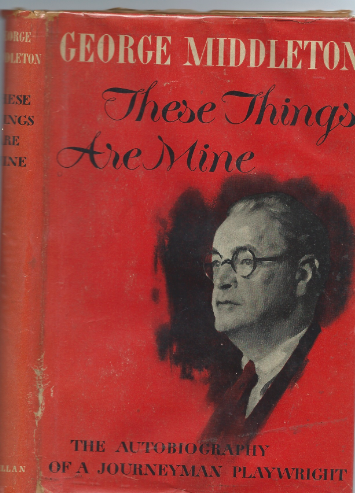
                                                      A loving memory from George Middleton

                  George Middleton was a Player for 40 years. In his autobiography, he describes in detail Sarah Bernhardtʼs visit to the Players in 1911.  
         “My one meeting was at the Players: a reception, one of the very few our club ever gave a woman. She plucked the carnations from a vase on a tea table by which she stood. She gave me mine. I can see the smile yet. Iʼll wager I am the only one who still has the flower. I have always been sentimental about the great ladies of the stage. Sentiment is all I could ever give them in return for what they have given me. Ada Rehan moves into my thoughts often, and even now, as I write. . . . But place a Sarah, for her little scene.

          " It is hardly anything---a flower, and a woman in a crowd; but I have kept the impression.  She was more than an individual, of course--such personalities suggest so much beyond their mere being; she was a world of emanations, the countless memories others like myself have kept alive which she gave birth to!  She was a tradition that those of us still living helped to make. She was to be the last of a royal line, and in her turn, had made the theatre of her time great. Also, she was unquestionably the most famous woman then alive. Yet, only a few years later, I was to stand at her grave...... 

           She came to the Club June 20, 1911, with a couple of secretaries and Lou Tellegen, her last romance. She was still able to walk in spite of her bad leg. She stood by the stairs to greet us with the spontaneous grace which had, no doubt, become a mechanical habit.  She wore a toque, on the side of which a bunch of grapes seemed mysteriously to dangle. Her hair edged about this---it was not gray, of course. The gown was of yellow lace, with golden buckles around her waist. The collar reached chin-high so that her neck was hidden; the sleeves ended in long points which left only the fingers visible. It was all designed to mask her age; for even then she was past sixty. " Her face was a marvel of make-up; the eyes shadowed, the cheeks without a wrinkle! The only time her age showed was when she smiled; for nothing could conceal the way the skin sank back around the mouth. She carried her habitual long scarf, wound around her back and over both arms. "

                     Francis Wilson, Vice President, greeted her in French. He didnʼt know French; but, to our astonishment, he had acquired this perfect sample. That was Frank. " She responded, full of emotion. How happy she was to be there! Her arms lifted up ecstatically and held high and pausing, for a moment, as I had so often seen her on the stage--while the long scarf hung from them, lining her in its frame. Her face at times was innocent, almost virginal; yet, in profile, it was a sphinx cynically guarding every secret of life she herself had devoured. It was a double woman I saw. As she talked, the scarf wound constantly with the serpent life she gave it.  We went out where tea was served. She stood by the table and poured. She hesitated to put sugar in one cup, as there were no prongs. A member gallantly begged her to use her fingers. She smiled and did. It was then she reached for the red carnations and gave them to us--to me; just so that I could write this now perhaps.

             A telegram from John Drew, our President, who was on the road, was passed to her. I was standing behind her when she eyed it, clasped it to her heart, overcome with sentiment. But I noticed that she held the wire upside down. With the resource of one who had forgotten a cue she handed it over and mentioned that it be read out loud. Some one translated it. She got it that way. How moved she was!

           A tactless, well intentioned member brought forward a photograph she had given the club many years before. The sun had faded it even more than time had touched her own youth. She looked at it and murmured softly in French, so that only those of us near could hear: “I will give you another, but not so pretty.”
      She kept her word. There hangs now in the clubhouse a striking photograph of her as Pierrot. Under it she wrote:
                      “Cʼetait pour les aveugles, fermez les yeux et admirez.”

POSTSCRIPT

This photo by Nadar may not be the one hanging in the clubhouse, but I found it on the Internet and thought it was appropriate.


George Middleton. These Things Are Mine The Autobiography of a Journeyman Playwright 
The Macmillan Company. New York. 1947

BOOK Cover portrait by Gordon Stevenson 
Book owned by Mari Lyn Henry

Monday, July 11, 2016


 MAYA ANGELOU AND
MAY MILLER MUST NEVER BE
FORGOTTEN!!!

Celebrate their poetry, their contributions to the Harlem Renaissance, education, African American culture and their storytelling brilliance.

May was born in Washington, D.C. in 1899; Maya was born in 1928 in St. Louis, Missouri.  Both women were civil rights activists and  their extraordinary achievements as poets, playwrights and teachers reflect their dedication and commitment to the betterment of all Black lives.  

As we have seen recently all lives matter but these two pioneering black women understood the need to write about the pain of separation and loneliness and struggle and challenges which their race were forced to endure.  I think there is no better evidence than to read some of their magnificent and visionary work.
                                               THE WASHINGTONIAN
                                                        May Miller

Possessed of this city, we are born
into kinship with its people
Eyes that looked upon
Cool magnificence of space,
The calm of marble,
And green converging on green
In long distances,
Bear their wonder to refute
Meaningless dimensions,
The Old-World facades.

The city is ours irrevocably
As pain sprouts at the edge of joy,
As grief grows large with our years.
New seeds push hard to topsoil;
Logic is a grafted flower
From roots in a changeless bed.
Skeleton steel may shadow the path,
Broken stone snag the foot,
But we shall walk again
Side by side with others on the street,
Each certain of his way home.

(http://www.poetryfoundation.org/poem236688)

                                                  STILL I RISE    
                                                  Maya Angelou

You may write me down in history
With your bitter, twisted lies,
You may trod me in the very dirt
But still, like dust, I'll rise.

Does my sassiness upset you?
Why are you beset with gloom?
'Cause I walk like I've got oil wells
Pumping in my room.

Just like moons and like suns,
Withe the certainty of tides,
Just like hopes springing high,
Still I'll rise.

Did you want to see me broken?
Bowed head and lowered eyes?
Shoulders falling down like teardrops.
Weakened by my soulful cries.

Does my haughtiness offend you?
Don't you take it awful hard
'Cause I laugh like I've got gold mines
'Diggin' in my own back yard.

You may shoot me with your words,
You may cut me with your eyes,
You may kill me with your hatefulness,
But still, like air, I'll rise.

Out of the huts of history's shame
I rise
Up rom a past that's rooted in pain
I rise
I'm a black ocean, leaping and wide,
Welling and swelling I bear in the tide.
Leaving behind nights of terror and fear
I rise
Into a daybreak that's wondrously clear
I rise
Bringing the gifts that my ancestors gave,
I am the dream and the hope of the slave....


Monday, June 13, 2016


LEST WE FORGET HELEN GAHAGAN DOUGLAS
IN HER OWN WORDS

TODAY'S WOMEN STAND ON HER SHOULDERS

As we have just been through a turbulent chapter in American political history regarding the selection of nominees for the next president of the United States, with more anticipated upheavals at the conventions and during the campaigns, we must remember one of the true democratic women who loved her country so much that she left a prosperous stage career in the dust to run for Congress in 1944.  Due to her liberal views about what needed to be done for social change and justice, she was branded a Communist sympathizer along with her well known husband Melvyn Douglas.  

"Immediately after my election, newspapers took up the theme that had been created in Chicago and spoke of the coming 'battle of the glamor queens' between me and Clare Boothe Luce.  We were two of the nine women in the House of Representatives in the Seventy-ninth Congress and there were none in the Senate.  Unlike the other seven, Mrs. Luce and I both were associated with the Broadway stage and both of us mingled with what was regarded as high society.
(Note: She determined not to let silly rivalry get in the way of her important job.)
    At a dinner hosted by the women of the Washington press corps, she looked forward to "an end to irresponsible stories that she and Mrs. Luce were feuding."
          "I stood for a long moment considering what I would say.....Then I began.
               'We're in a war.  My husband is overseas.  I will be in Washington with two small children. I came here to support our country's war effort and to do what I can in Congress to help bring the fighting to a successful end as soon as possible. I'm not here for petty quarrels or a competition with anyone, and certainly not with Clare Booth Luce."      Clare jumped to her feet, leaned across the distance between us and extended her hand.  We shook, grinning.

OBSERVATIONS    
      CAMPAIGN FINANCE
        "Politicians when elected tend to put on blindfolds and vote in ways they believe will get them support and campaign contributions.  This dependence on large private contributions is demoralizing to elected officials.  We've got to put an end to it.  Campaigns should be financed from tax money if we really mean to maintain a democratic system.  Television and radio should be available to candidates on a fair basis without the impossible costs that are being charged today.
       Politicians aren't any more wicked than other citizens but the situation in which they are placed warps their judgment.  Wealthy self-interest groups such as the oil barons or Associated Farmers have a lot of power. If you're in office, you don't want them working against you in the next election. Unless you are very deeply committed to a program, as I was to reclamation, the temptation is to make concessions and even to reverse your position."

EMPOWERMENT OF WOMEN
           What we want to get at is the root of woman's problems---inferiority. At the beginning of the century a few women tenaciously worked, struggled, endured ridicule--even imprisonment--to obtain the vote. They believed we must share political power if we were to gain independence. They won the first round.....
          The female has to be trained from childhood to develop interests and abilities, to be aware of her capacities.  A woman must be given the resources necessary to build an inner life so she can respect herself.

THE POWER OF LIVING THEATER
             Everything one does that is verbal helps to make the mind function. When we attend living theater we make an effort to get there.  We set an evening aside for a special entertainment, rather than having it come into our homes via a television set. We purchase tickets. Then, there is the impact between the actor and the listener. The more knowledgeable the audience is about itself, and about the world, the better the actor".

AN EXCERPT FROM HER MEMORIAL BY ABE FORTAS. (U.S. Supreme Court Associate Justice 1965-1969)

"In the paranoia of 1950, there was no chance that Helen could survive an attack of the intensity which was launched against her largely on the basis of her civil rights record.
     Even as the sordid events of Watergate were unfolded and it became common parlance to point to the evil aspects of Mr. Nixon's record, Helen remained silent and aloof--a gentlewoman, a person of impeccable taste and essential kindness in vindication as she had been in battle and in defeat...
     On the night of December 10, 1977 she rose before a large audience in a New York theater. Radiant in spite of her terminal illness, she read the magnificent words of the Fifth Amendment to our Constitution, followed by a standing ovation.

Postscript: If only Mrs. Douglas could have witnessed the victory of Hillary Rodham Clinton for the first female president of the United States, what an endorsement she would have written as a testimony to HER belief in the power of women.

Resource: A Full Life. Helen Gahagan Douglas. Doubleday & Company, NY 1982

Friday, June 3, 2016

Dear Readers,
      I am writing to you as Clara Morris, (an actress of the 19th century who I have chosen to portray in the program Stage Struck).  Mark Twain, the legendary American humorist, was a fan of mine. He introduced me at a lecture event where I was talking about Life on the Stage when the original person assigned failed to appear.  He was extremely complimentary and I was very grateful for his ability to improvise on the spot without rehearsal.  Mark Twain loved the theatre and those who were a part of it.

He loved women and indeed was an advocate for women's rights.  On January 21, 1901, he spoke to members of the Hebrew Technical School for Girls at their annual meeting on the issue of female suffrage.  I am pleased to share with you what he told the packed audience.

"I know that since the women started out their crusade they have scored in every project they undertook against unjust laws. I would like to see them help make the laws and those who are to enforce them. I would like to see the whiplash in women's hands.  The suffrage in the hands of the men degenerates into a couple of petrified parties. The man votes for his party and gets the city in the condition this one is in now - a disgrace to civilization.  If I live seventy-five years more - well, I won't - fifty years, then, or twenty-five, I think I'll see women use the ballot. It's the possession of the ballot that counts.  If women had it you could tell how they would use it.

Bring before them such a state of affairs as existed in New York City today and they would rise in their strength at the next election, elect a mayor, and sweep away corruption.
                                              True, they might sit ten years and never use it, but on such occasions they would cast it. Or in the case of an unjust war. Why, war might even pass away and arbitration take its place.  It never will so long as men have the votes.
                                           
                                             The contention that only vicious women would vote is absurd. How many of our 600,000 women are vicious?  Not enough to amount to anything. If women could vote, each party would feel compelled to put up the best candidate it could or take the risk of being voted down by the women.  States are built on morals - not intellects And men would never get any morals at all if the women didn't put it into them when they were boys.  If women could vote the good women would all vote one ..Men won't do that. It's a choice of evils with them."

According to  President Nathaniel Myers who introduced Mr. Twain, the Hebrew Technical School for Girls (2nd Ave. and E. 15th St.) was in the midst of ongoing expansion. He explained that the unique purpose as the single society in New York City was to offer a vocational education to Jewish girls.  He declared the work of the school to  be vital in a world where girls were too often forgotten.   (Reference:  www.jfew.org/?history_mark_twain)

Dear Mark Twain, he passed away from us on April 21, 1910 just nine years short of its passage by Congress and ten years short of is ratification as the 19th Amendment.  But I feel he was smiling on high for the women finally getting their right to vote.

                                                                 Respectfully,
                                                                                                   Clara Morris Marriott