Thursday, July 28, 2016


GEORGE ADE, HOOSIER HUMORIST, PLAYWRIGHT, JOURNALIST, STORYTELLER

(1866 - 1944)

REMEMBERING HIS VALUES, CHARACTER, PHILOSOPHY ESPECIALLY DURING THE POLITICAL CAMPAIGNS OF 20016

Before his death, he knew that life had been good to him. "I feel that I have been fortunate in arriving on earth just when things were beginning to happen. As a member of the reception committee I have greeted the telephone, the electric light, the airplane, motor cars, moving pictures, radio, concrete highways, electric refrigeration, air conditioning, woman suffrage, television, and a lot of interesting by-products...It's a great world and most of the people are worth knowing. I am glad to have been among those present."  But it was in his essay, "The Yankee's Prayer" that his philosophy was eloquently expressed and inspirational.   Here below is the text.

Help me to get things straight. Give me an outlook on the whole world. Open my eyes to the truth regarding the material wealth and the golden opportunity of my native land, but strike me with swift punishment if I roll my 'r's in speaking the "great" or feed the vanity of my ignorant neighbors who think that the U.S.A. has become a symbol of perfection.

Help me to understand that the comforts and luxuries and pleasant accessories of modern life abound in my bailiwick because my friends and I have moved into a new country in which there is much recent wealth to be divided.  Teach me to modify my sense of importance with an humble thankfulness.

     Save me from delusions regarding continued and abounding prosperity. Give me the wisdom to preach against wastefulness.

     Incline me to avoid boasting, but keep me from being an idle weeper or an idle faultfinder. Let me read history aright and learn that a people seldom can be made happy and prosperous by involved and ponderous legislation. Assist me and my associates to look to ourselves and not to Congress.

     Give me patience and tolerance and strength to brace myself against sudden and hysterical and gusty changes of popular feeling.  Let me not construe the rule of the majority into a fool axiom that the majority is always right. Cause me to bear in mind that in every age of which we have record, an unpopular minority advanced measures, which, later on, were accepted by the majority.

    Protect me against labels and memberships and binding obligations which will submerge me as an individual. Save me from being enslaved or hampered by catch-phrases. May I never take orders which will make me a coward in the sight of my conscience. Let it not be said of me that I "belong" to a political party.

    Lead me to an understanding of the new meaning of "service."  Help me to believe that the man prospers best and longest who is concerned as to the welfare of the people about him. Compel me to see that our organization is a huge experiment in cooperation and not a scramble for prizes.

    Give me large portions of charity with which to regard the performances of my easy-going countrymen. Help me to judge every act by the intent of it.

    Increase my usefulness by giving me an X-ray vision, so that I may detect the goodness and deservedness of those who do not wear my kind of clothes, worship in my church or live in my township.  Make it open to me that integrity and patriotism cannot be monopolized.

   Keep me from trouble, but make me dangerous if I am drawn into a fight. Convince me that every battle should be fought to a finish, so there will not be any argument later on.

   LET me remain level-headed when I am envied by the people of other lands, but do not take away the things which arouse their envy. PERMIT me to retain my heritage as long as I know how to take care o fit.

Reference:
Google search
Wikipedia: George Ade
Kelly, Fred C.  GEORGE ADE WARMHEARTED SATIRIST. 1947


Thursday, July 14, 2016

                                               SARAH BERNHARDT AT THE PLAYERS IN 1911
                                                      A loving memory from George Middleton

                  George Middleton was a Player for 40 years. In his autobiography, he describes in detail Sarah Bernhardtʼs visit to the Players in 1911.  
         “My one meeting was at the Players: a reception, one of the very few our club ever gave a woman. She plucked the carnations from a vase on a tea table by which she stood. She gave me mine. I can see the smile yet. Iʼll wager I am the only one who still has the flower. I have always been sentimental about the great ladies of the stage. Sentiment is all I could ever give them in return for what they have given me. Ada Rehan moves into my thoughts often, and even now, as I write. . . . But place a Sarah, for her little scene.

          " It is hardly anything---a flower, and a woman in a crowd; but I have kept the impression.  She was more than an individual, of course--such personalities suggest so much beyond their mere being; she was a world of emanations, the countless memories others like myself have kept alive which she gave birth to!  She was a tradition that those of us still living helped to make. She was to be the last of a royal line, and in her turn, had made the theatre of her time great. Also, she was unquestionably the most famous woman then alive. Yet, only a few years later, I was to stand at her grave...... 

           She came to the Club June 20, 1911, with a couple of secretaries and Lou Tellegen, her last romance. She was still able to walk in spite of her bad leg. She stood by the stairs to greet us with the spontaneous grace which had, no doubt, become a mechanical habit.  She wore a toque, on the side of which a bunch of grapes seemed mysteriously to dangle. Her hair edged about this---it was not gray, of course. The gown was of yellow lace, with golden buckles around her waist. The collar reached chin-high so that her neck was hidden; the sleeves ended in long points which left only the fingers visible. It was all designed to mask her age; for even then she was past sixty. " Her face was a marvel of make-up; the eyes shadowed, the cheeks without a wrinkle! The only time her age showed was when she smiled; for nothing could conceal the way the skin sank back around the mouth. She carried her habitual long scarf, wound around her back and over both arms. "

                     Francis Wilson, Vice President, greeted her in French. He didnʼt know French; but, to our astonishment, he had acquired this perfect sample. That was Frank. " She responded, full of emotion. How happy she was to be there! Her arms lifted up ecstatically and held high and pausing, for a moment, as I had so often seen her on the stage--while the long scarf hung from them, lining her in its frame. Her face at times was innocent, almost virginal; yet, in profile, it was a sphinx cynically guarding every secret of life she herself had devoured. It was a double woman I saw. As she talked, the scarf wound constantly with the serpent life she gave it.  We went out where tea was served. She stood by the table and poured. She hesitated to put sugar in one cup, as there were no prongs. A member gallantly begged her to use her fingers. She smiled and did. It was then she reached for the red carnations and gave them to us--to me; just so that I could write this now perhaps.

             A telegram from John Drew, our President, who was on the road, was passed to her. I was standing behind her when she eyed it, clasped it to her heart, overcome with sentiment. But I noticed that she held the wire upside down. With the resource of one who had forgotten a cue she handed it over and mentioned that it be read out loud. Some one translated it. She got it that way. How moved she was!

           A tactless, well intentioned member brought forward a photograph she had given the club many years before. The sun had faded it even more than time had touched her own youth. She looked at it and murmured softly in French, so that only those of us near could hear: “I will give you another, but not so pretty.”
      She kept her word. There hangs now in the clubhouse a striking photograph of her as Pierrot. Under it she wrote:
                      “Cʼetait pour les aveugles, fermez les yeux et admirez.”

POSTSCRIPT

This photo by Nadar may not be the one hanging in the clubhouse, but I found it on the Internet and thought it was appropriate.


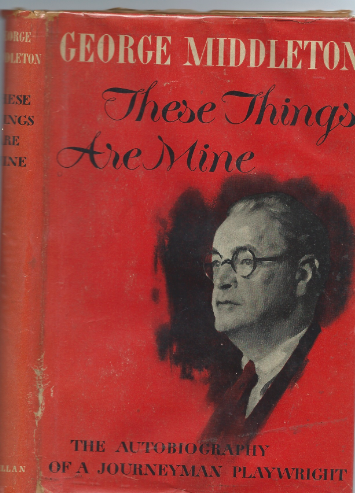
George Middleton. These Things Are Mine The Autobiography of a Journeyman Playwright 
The Macmillan Company. New York. 1947

BOOK Cover portrait by Gordon Stevenson 
Book owned by Mari Lyn Henry

Monday, July 11, 2016


 MAYA ANGELOU AND
MAY MILLER MUST NEVER BE
FORGOTTEN!!!

Celebrate their poetry, their contributions to the Harlem Renaissance, education, African American culture and their storytelling brilliance.

May was born in Washington, D.C. in 1899; Maya was born in 1928 in St. Louis, Missouri.  Both women were civil rights activists and  their extraordinary achievements as poets, playwrights and teachers reflect their dedication and commitment to the betterment of all Black lives.  

As we have seen recently all lives matter but these two pioneering black women understood the need to write about the pain of separation and loneliness and struggle and challenges which their race were forced to endure.  I think there is no better evidence than to read some of their magnificent and visionary work.
                                               THE WASHINGTONIAN
                                                        May Miller

Possessed of this city, we are born
into kinship with its people
Eyes that looked upon
Cool magnificence of space,
The calm of marble,
And green converging on green
In long distances,
Bear their wonder to refute
Meaningless dimensions,
The Old-World facades.

The city is ours irrevocably
As pain sprouts at the edge of joy,
As grief grows large with our years.
New seeds push hard to topsoil;
Logic is a grafted flower
From roots in a changeless bed.
Skeleton steel may shadow the path,
Broken stone snag the foot,
But we shall walk again
Side by side with others on the street,
Each certain of his way home.

(http://www.poetryfoundation.org/poem236688)

                                                  STILL I RISE    
                                                  Maya Angelou

You may write me down in history
With your bitter, twisted lies,
You may trod me in the very dirt
But still, like dust, I'll rise.

Does my sassiness upset you?
Why are you beset with gloom?
'Cause I walk like I've got oil wells
Pumping in my room.

Just like moons and like suns,
Withe the certainty of tides,
Just like hopes springing high,
Still I'll rise.

Did you want to see me broken?
Bowed head and lowered eyes?
Shoulders falling down like teardrops.
Weakened by my soulful cries.

Does my haughtiness offend you?
Don't you take it awful hard
'Cause I laugh like I've got gold mines
'Diggin' in my own back yard.

You may shoot me with your words,
You may cut me with your eyes,
You may kill me with your hatefulness,
But still, like air, I'll rise.

Out of the huts of history's shame
I rise
Up rom a past that's rooted in pain
I rise
I'm a black ocean, leaping and wide,
Welling and swelling I bear in the tide.
Leaving behind nights of terror and fear
I rise
Into a daybreak that's wondrously clear
I rise
Bringing the gifts that my ancestors gave,
I am the dream and the hope of the slave....


Monday, June 13, 2016


LEST WE FORGET HELEN GAHAGAN DOUGLAS
IN HER OWN WORDS

TODAY'S WOMEN STAND ON HER SHOULDERS

As we have just been through a turbulent chapter in American political history regarding the selection of nominees for the next president of the United States, with more anticipated upheavals at the conventions and during the campaigns, we must remember one of the true democratic women who loved her country so much that she left a prosperous stage career in the dust to run for Congress in 1944.  Due to her liberal views about what needed to be done for social change and justice, she was branded a Communist sympathizer along with her well known husband Melvyn Douglas.  

"Immediately after my election, newspapers took up the theme that had been created in Chicago and spoke of the coming 'battle of the glamor queens' between me and Clare Boothe Luce.  We were two of the nine women in the House of Representatives in the Seventy-ninth Congress and there were none in the Senate.  Unlike the other seven, Mrs. Luce and I both were associated with the Broadway stage and both of us mingled with what was regarded as high society.
(Note: She determined not to let silly rivalry get in the way of her important job.)
    At a dinner hosted by the women of the Washington press corps, she looked forward to "an end to irresponsible stories that she and Mrs. Luce were feuding."
          "I stood for a long moment considering what I would say.....Then I began.
               'We're in a war.  My husband is overseas.  I will be in Washington with two small children. I came here to support our country's war effort and to do what I can in Congress to help bring the fighting to a successful end as soon as possible. I'm not here for petty quarrels or a competition with anyone, and certainly not with Clare Booth Luce."      Clare jumped to her feet, leaned across the distance between us and extended her hand.  We shook, grinning.

OBSERVATIONS    
      CAMPAIGN FINANCE
        "Politicians when elected tend to put on blindfolds and vote in ways they believe will get them support and campaign contributions.  This dependence on large private contributions is demoralizing to elected officials.  We've got to put an end to it.  Campaigns should be financed from tax money if we really mean to maintain a democratic system.  Television and radio should be available to candidates on a fair basis without the impossible costs that are being charged today.
       Politicians aren't any more wicked than other citizens but the situation in which they are placed warps their judgment.  Wealthy self-interest groups such as the oil barons or Associated Farmers have a lot of power. If you're in office, you don't want them working against you in the next election. Unless you are very deeply committed to a program, as I was to reclamation, the temptation is to make concessions and even to reverse your position."

EMPOWERMENT OF WOMEN
           What we want to get at is the root of woman's problems---inferiority. At the beginning of the century a few women tenaciously worked, struggled, endured ridicule--even imprisonment--to obtain the vote. They believed we must share political power if we were to gain independence. They won the first round.....
          The female has to be trained from childhood to develop interests and abilities, to be aware of her capacities.  A woman must be given the resources necessary to build an inner life so she can respect herself.

THE POWER OF LIVING THEATER
             Everything one does that is verbal helps to make the mind function. When we attend living theater we make an effort to get there.  We set an evening aside for a special entertainment, rather than having it come into our homes via a television set. We purchase tickets. Then, there is the impact between the actor and the listener. The more knowledgeable the audience is about itself, and about the world, the better the actor".

AN EXCERPT FROM HER MEMORIAL BY ABE FORTAS. (U.S. Supreme Court Associate Justice 1965-1969)

"In the paranoia of 1950, there was no chance that Helen could survive an attack of the intensity which was launched against her largely on the basis of her civil rights record.
     Even as the sordid events of Watergate were unfolded and it became common parlance to point to the evil aspects of Mr. Nixon's record, Helen remained silent and aloof--a gentlewoman, a person of impeccable taste and essential kindness in vindication as she had been in battle and in defeat...
     On the night of December 10, 1977 she rose before a large audience in a New York theater. Radiant in spite of her terminal illness, she read the magnificent words of the Fifth Amendment to our Constitution, followed by a standing ovation.

Postscript: If only Mrs. Douglas could have witnessed the victory of Hillary Rodham Clinton for the first female president of the United States, what an endorsement she would have written as a testimony to HER belief in the power of women.

Resource: A Full Life. Helen Gahagan Douglas. Doubleday & Company, NY 1982

Friday, June 3, 2016

Dear Readers,
      I am writing to you as Clara Morris, (an actress of the 19th century who I have chosen to portray in the program Stage Struck).  Mark Twain, the legendary American humorist, was a fan of mine. He introduced me at a lecture event where I was talking about Life on the Stage when the original person assigned failed to appear.  He was extremely complimentary and I was very grateful for his ability to improvise on the spot without rehearsal.  Mark Twain loved the theatre and those who were a part of it.

He loved women and indeed was an advocate for women's rights.  On January 21, 1901, he spoke to members of the Hebrew Technical School for Girls at their annual meeting on the issue of female suffrage.  I am pleased to share with you what he told the packed audience.

"I know that since the women started out their crusade they have scored in every project they undertook against unjust laws. I would like to see them help make the laws and those who are to enforce them. I would like to see the whiplash in women's hands.  The suffrage in the hands of the men degenerates into a couple of petrified parties. The man votes for his party and gets the city in the condition this one is in now - a disgrace to civilization.  If I live seventy-five years more - well, I won't - fifty years, then, or twenty-five, I think I'll see women use the ballot. It's the possession of the ballot that counts.  If women had it you could tell how they would use it.

Bring before them such a state of affairs as existed in New York City today and they would rise in their strength at the next election, elect a mayor, and sweep away corruption.
                                              True, they might sit ten years and never use it, but on such occasions they would cast it. Or in the case of an unjust war. Why, war might even pass away and arbitration take its place.  It never will so long as men have the votes.
                                           
                                             The contention that only vicious women would vote is absurd. How many of our 600,000 women are vicious?  Not enough to amount to anything. If women could vote, each party would feel compelled to put up the best candidate it could or take the risk of being voted down by the women.  States are built on morals - not intellects And men would never get any morals at all if the women didn't put it into them when they were boys.  If women could vote the good women would all vote one ..Men won't do that. It's a choice of evils with them."

According to  President Nathaniel Myers who introduced Mr. Twain, the Hebrew Technical School for Girls (2nd Ave. and E. 15th St.) was in the midst of ongoing expansion. He explained that the unique purpose as the single society in New York City was to offer a vocational education to Jewish girls.  He declared the work of the school to  be vital in a world where girls were too often forgotten.   (Reference:  www.jfew.org/?history_mark_twain)

Dear Mark Twain, he passed away from us on April 21, 1910 just nine years short of its passage by Congress and ten years short of is ratification as the 19th Amendment.  But I feel he was smiling on high for the women finally getting their right to vote.

                                                                 Respectfully,
                                                                                                   Clara Morris Marriott


Sunday, May 29, 2016

May Robson roles as of 1905


REMEMBERING MAY ROBSON
April 19, 1858 - October 20, 1942

"I was born in the Australian bush.  I remember when I was a young girl fishing from the St. Kilda Pier in Melbourne.  At 13 my family moved from Melbourne to England across the Pacific. We sailed in a vessel modeled after my grandmother's rocking chair in movement and it was dubbed the "Rolling Moses."
       She attended La Sainte Union Catholic School on Highgate Road. "From the Sacred Heart Convent, Highgate, I was sent to school at Brussels, and there I studied the languages. I went to Paris for my examinations in French and returned home for a vacation.  I ran away from home to marry a boy of eighteen and we went to Fort Worth, Texas and tried to live up to our dignified name as inscribed on our cards, 'Mr. and Mrs. Charles Livingston Gore'."
                                                                                                                                                                                     From an article that appeared in Theatre (1907)                                                                                                                    
She arrived in New York in 1880 with her young husband and three children and had to begin life anew after severe financial losses.  Her husband preferred to return to London to recoup some of his finances; May decided to stay in New York.  To survive she produced crocheted hoods and embroidery, designed dinner cards and taught painting to support her three children. Her youngest son and daughter died in 1882.

A LIFE ON THE STAGE
     She debuted as an actress on September 17, 1883 as Tilly in Hoop of Gold at the
Brooklyn Grand Opera House.  Heretofore her maiden name was Robison, now an
incorrect spelling on the playbill as Robson became her chosen last name for "good luck".

      Her success was partly due to her affiliation with Charles Frohman and the Theatrical Syndicate. By 1911 she established her own touring theatrical company.

According to the bio in Who's Who in the Theatre by John Parker, between 1884 and 1921 she appeared on Broadway or on tour in over sixty productions.  To name a few,  Mrs. Chapstone in
Jim the Penman, Mrs.Van Buren in The Charity Ball, Audrey in As You Like It.
                        Between 1893-1896 she was engaged at the
Empire Theatre under the management of Charles Frohman in the following productions: Liberty Hall, The Councillor's Wife,
Sowing the Wind,  Gudgeons,  The Luck of Roaring Camp, 
The Importance of Being Earnest, Bohemia, among others.
Theatres who engaged her included Palmer's, Miner's Fifth Avenue,  Hoyt's, the Lyceum, Daly's and Wallack's and the
New York.  She also appeared in a vaudeville sketch entitled "Cinders" at Lew Fields' Theatre in 1904.

DEBUT AS A STAR
      She originated the role of Aunt Mary Watkins in
The Rejuvenation of Mary appearing in New York after a tryout at the Garden Theatre in 1907. She debuted in London with the same role at Terry's Theatre in 1910.    There would be at least ten more character roles by the end of 1922.      For a woman with no apparent training, except for life experience, she had phenomenal luck as a working actress and so many roles that were just right for her comedic timing and instinctive characterizations.

She performed a cameo in the 1915 silent film, How Molly Made Good and in 1916 starred in the film  A Night Out, an adaptation of a play she co-wrote The Three Lights. Other silents included roles in the King of Kings (1927), The Rejuvenation of Aunt Mary (1927) and Chicago (1927).

HOLLYWOOD TALKIES COME A CALLING
       With her distinctive speaking voice and extensive stage experience, it is no wonder that Hollywood moguls and directors would request her for her brilliance as a solid character woman and comedienne.  In The She Wolf (1931) she was a miserly millionaire businesswoman; in the final segment of If I Had A Million (1932)  she was a rest home resident who gets a new lease on life when she is given a million dollar check by a dying business tycoon. She played the Queen of Hearts in Alice in Wonderland (1933), Countess Vronsky in Anna Karenina (1936), Aunt Elizabeth in
Bringing Up Baby (1938), Aunt Polly in The Adventures of Tom Sawyer (1938) and a sharp-tongued Granny in A Star is Born. (1937)
     
In 1933, she was nominated for an Academy Award at age 75 in the Best Actress category for Lady for a Day but lost to Katharine Hepburn.  She was the first Australian-born actress to be nominated for an acting Oscar, and for many years she held the record as the oldest performer nominated for an Oscar.

She wrote an article entitled "Make-Up--A Paradox"
for Making Up A Practical and Effective Treatise on this Art for Professional and Amateur by Actor James Young (1905)

"Let me say that I do not think that I have ever met two faces that should be made up exactly alike. I am talking about "straight make-up." You often see a girl who looks remarkably pretty on the street and who is comparatively a fright when she gets on the stage; and a girl really plain who seems pretty behind the footlights.  Make-up can be very cruel or very kind........
                                                  "As to costumes, my advice is to get the real thing when you can. The old coat I wore some years ago in  Lady Bountiful  (1892)I remember I bought from a woman in Newark, who was very glad to exchange it for a new one. When I cannot get the real thing I reproduce it as closely as I possibly can."

After her death at age 84 the New York Times obituary called her "the dowager queen of the American screen and stage."

Resources: Watch as many of the 34 motion pictures which starred or featured this iconic and brilliant woman.  My favorites are  Lady For A Day, Bringing Up Baby, Four Daughters, Irene, 
Wife vs. Secretary and Reckless.

Reference:  May Robson  Wikipedia

Monday, May 23, 2016

EDWIN BOOTH AT 19


The year was 1852, a young rising star, the son of the great Junius Brutus Booth, was in financial straits.  Most of the money earned from touring had been squandered by his father's self-indulgence and addictions.

However, there was an inner strength and instinct for survival in the rugged mining towns of Northern California that only fueled the young man's passion for succeeding on the stage--the only occupation he knew anything about, the one true love in his lonely life.


Eleanor Ruggles wrote a well-researched narrative about him entitled The Prince of Players and this excerpt defines how that phrase applied to him and to the miners for whom he performed.


Excerpt from  Prince of Players Edwin Booth by Eleanor Ruggles
Norton,  New York. 1953  pp. 57-60

SEEING THE ELEPHANT
Miners and travel obstacles in the 19th century

         California had an expression: “Seeing the elephant.” It had been the  title of a skit satirizing the gold rush that had run in San Francisco for months. “To see the elephant” meant to trek hopefully to the gold country and be (what most people were) viciously disappointed.  The West took up the ironic idiom.   All rugged travel, hunger and heartbreaking bad luck were “seeing the elephant.”  Miners had elephants stamped on their letter paper and daubed them in red and black on their cabin walls.
         The Booths had caught a glimpse of the elephant in Sacramento. Now Edwin got a good look from trunk to tail.  At first his his father (Junius Brutus Booth) had left, he lingered on with Junius (his older brother) and Harriet in their house on Telegraph Hill, an exasperating guest.  Having no work, he spent his time drinking in saloons where the bars were still warm from his father’s instep. His nineteenth birthday (November 13, 1852) came and went. Junius was mightily relieved when Willmarth Waller, an actor-manager organizing a company to play the mining towns engaged Ted for the tour. “The name will help me anyway,” said Waller.
         Junius had learned a thing or two about how to survive in California. It was the survival of the cautious. His brother was a brash kid, and Junius advised him before starting out to “put a slug” which was a piece of gold worth fifty dollars, “in the bottom of your trunk, forget you have it, and when things are at their worst bring out your slug.”
                  At Sacramento they all changed steamers and churned up the Feather River to Marysville.  Then, piling into a coach, they jolted for miles across plains whose horizons were ringed at night by the red pillars of campfires. They inched in silence, muffling all harness noise, through bandit country where mustachioed highwaymen like Joaquin Murietta could be expected to take shape silently out of the brush.  Now and then a grizzly lumbered across the trail.  Through the night the coyotes howled. The sturdy horses braced their hoofs as they picked their way down pebbly forest paths. From the hillttops the swaying, singing coachload glimpsed an occasional white tent roof or a thread of smoke showing the whereabouts of some lonely fortune hunter.
         Some of the mining towns had real playhouses with a sign over the door announcing THEATER or DRAMATIC HALL in five-foot letters, and inside kerosene footlights and drop curtains with pictures of elephants or of a miner recumbent, his pick by his side, dreaming of home. But often traveling actors played in a calico-draped saloon on a stage of boards help up by sawhorses, or in somebody’s barn or warehouse where the all-male audience planted stools on the dirt floor and belligerently staked off places like claims.
         Waller’s troupe stopped first in Nevada City, a clump of shacks in a clearing among the tall pines, and Edwin acted his first Iago.  They played next in Grass Valley, then in Rough and Ready, then in distant Downieville on the North Yuba at the deep bottom of a valley high in the mountains. The more remote the camp, the more electric the tension in the audience of tough-looking miners who sat with their guns handy in their laps. If you could capture them they showered you with gold pieces; if you disappointed them they tossed you in a blanket. Many of them knew the classical texts by heart and yowled with irritation when the smallest cut was made.
         The actors were in Downieville when a tremendous blizzard struck. Waller herded them back along the trail as far as Grass Valley. Here the snow lay twelve feet deep in places, and food was so short and fantastically expensive that Edwin’s precious slug, fetched out of his trunk to meet the emergency, bought the company no more than one dinner. They forced themsleves out and on again to Nevada City, hoping to earn enough there to pay for the steamer trip home. But when they reached town on an icy December night they found the dramatic hall dark.
         For many days neither food not letters had got through to the camps. The stranded miners had no money for theaters.  The stranded actors huddled around the stove in the dismal hotel and began to swap stories out of their accumulated experience of their catastrophes.
         Edwin flung away and wandered off alone down the main street, which led out of the camp into a no man’s land pitted like a moon landscape with gulches left by the gold diggers.  The snow made the night look almost bright and the raw holes sculptured. He was on his way back when he saw a lantern bobbing, heard shouts and running footsteps.
         “Holla!” rang George Spear’s (a member of the company) voice, sounding half-frozen, “Ted, is that you?”
         “Yes, what’s up?”
         “There’s mail just in and a message for you.”
         “What news?”
         “Not good news for you, my boy.”

         Edwin, like his father, occasionally had premonitions, true guesses at dark events. “Spear,” he asked instantly, “is my father dead?” Spear nodded slowly.